Bibliophilia (2025) – film in progress
“Artist’s Statement: an interview with an imaginary interviewer” (December, 2025)
I thought we might start with the core idea of your film. Why make a film about books?
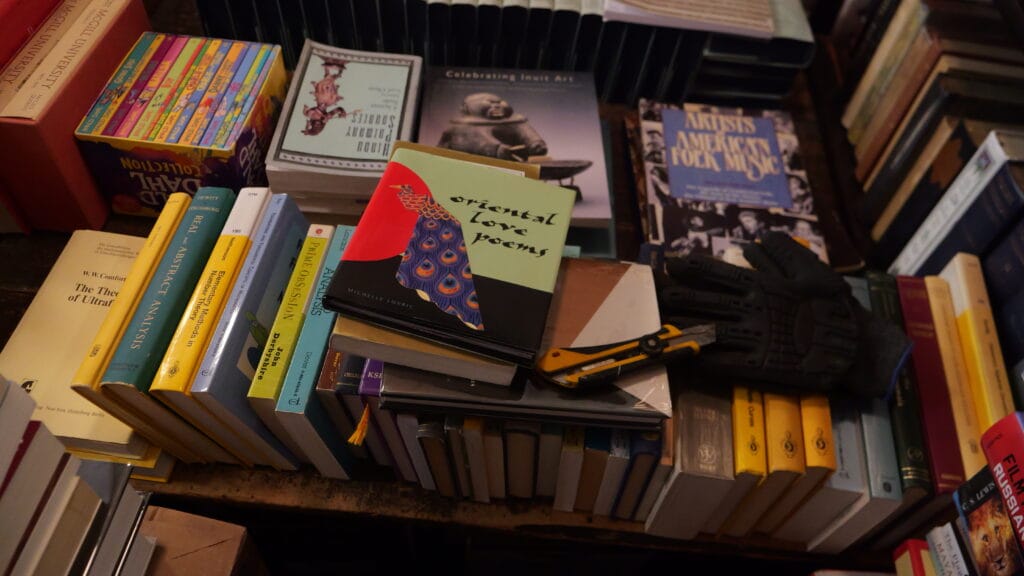
When you browse through books, it is a chance encounter. You don’t know what is going to happen. You might find a book that is going to steer your life in new directions. It may ask you to revisit the past, inspire new passions, or simply transport you to another place that you rather be. This first moment of interaction with the book is precious and I see it as some kind of flirting. So, browsing at a library or bookstore is like flirting with books. Flirting is playful and therefore pleasant because it promises the climax of a feeling or of a story. It may or may not happen. Flirtatious, we come forward to a book that attract us. Sometimes it is because of a title we have heard of, but it can also be because we like the color of the cover, the smell of the pages, or the sound of the author’s name in our lips. This initial pull makes us want to learn more about it, and so we turn the pages. And the page might feel thin or thick, we might feel the cover bending or not, and the font can please or challenge the eyes. All these sensorial inputs are being processed while we read the scattered phrases hinting at beautiful landscapes, complex characters and contradictory emotions. Of course, we can’t make sense of the story or content at that moment, so the sensorial experience of the book might make up for what we can’t yet apprehend about it. It is a suggestive experience. In this dance between hands and pages, gestures and words, we might fall for their charm or decide it is not for us and move on.
Was there something that you were trying to achieve with this film?
The feeling of a book, that is the point of the film and is the point of reading a physical book rather than a pdf. When I read for work, I most often read pdfs. When I read for pleasure, I read physical books. But when I read for work a physical book, it becomes pleasant too.
There are other messages as well. Last year, McGill library decided to move its physical books to a warehouse outside Montreal. The main library shelves have therefore been emptied and dismantled. I see this transition as symbolic of the continuous modernization in our everyday cultural habits (like going to search for a book at a library) but also evidence of change in our relationship to books. The question I pursued in this film was, is: what is lost when we go digital – whether for reading or browsing purposes? The answer is what I tried to show in the film: the cognitive, social, physical and I would even say at times spiritual encounter with a book, and the humane quality of a bookstore.
You mention this analogy of flirting and encountering books. How is this idea of flirting present in the film?
First, I was thinking about art, whether it be writing, filming, or painting, as means to communicate deeply with others, which is something I find difficult. As I kept thinking about communication while I sorted the footage, I begun to realize that the people and the books were communicating in a way, trying to know each other. The hands are all over the book, trying to decipher it before committing to a purchase. From there, I thought courting or flirting was a better frame to see it, because there is a kind of hesitation and tension when people first touch a book that is like flirting. It can even be a little scary to find a really good book. So, that helped with timing in the editing, especially for my Critique version. In the new edits, this was still in my mind, but I tried to trust the footages more and let it speak for itself.
I did not see the connection in the film, but I understand how it can be useful to have a concept to work with during editing. How does the goals of the film relate to some themes and concerns present at your Sensory Ethnography class?
There is the goal amongst some visual anthropologists to use audiovisual techniques to make visible or bring to attention a topic that is in the shadows or flattened by the written word. By focusing on the physical encounter with books, we can circle this moment unbounded by words. Likewise, audiovisual may convey sensory experiences of reading a physical book to the viewer. By looking at images of people flipping through pages, gazing intensely at a shelf, or smelling a book, they might find pathways to connect to the senses elicited by those images that words alone couldn’t. We also discussed consent and the tension between wanting to be filmed and not being sure if the image will make justice to one’s uniqueness. In my experience, whenever I asked people to be filmed, they started acting consciously and in a boring way. The shots that people acted like themselves occurred at the frontier of consent. I was shy to film them abruptly, so I circled them until we were both comfortable. It is something that I at least could feel. The feeling that they weren’t sure if they were being filmed, but because I was distanced enough they could still act like themselves, but I have been close enough for long enough so they know being filmed is a possibility.
I’ve heard there are a lot of readings in this class. What are some of the core ideas from these texts, and have you seen it elsewhere or tried to reproduce it in your film?
Yes, I am still catching up with the readings! In “On the Documentary,” Harun Farocki says that “documentarians want the effect of imperfections without a demonstration of their clumsiness” (p. 3) differently from classical features films where movement and intention are staged. The documentarian pursues their image. Farocki questions why the documentarian wants to prove that she can foresee a subjects’ movement, and I think it is simply because people (especially non-professional actors) act differently when they know they are being observed. So, when staged, intention becomes calculated and loses the spontaneity in which we can learn from someone’s idiosyncratic behavior.
This idea of pursuing the image is captured in Hale County [21:40] when Ross follows little Kyrie running around the living room and anticipates his movements with the camera. The shot is imperfect; there are times we miss Kyrie from the frame, but at no moment he loses Kyrie’s direction completely, so it looks like he could premeditate Kyrie’s movement, follow along his intentions. If Kyrie would change direction abruptly and Ross be unable to anticipate, he would have to decide whether to focus on something else, or move the camera back to where Kyrie went and run the risk of seeming “clumsy.”
In the new edits [00:03], I included a conversation between two men who met at the bookstore that illustrate this idea. I was trying to catch their expressions and hand gestures, but because the camera was zoomed in, I could only frame parts of them at a time. So, I had to decide on which person to focus first regardless of who was speaking, since if I strictly followed the speaker, I would risk looking clumsy each time I missed who the speaker was. In this way, I attempted at an imperfect shot that feels premeditated rather than accidental or lucky.
I think the shot looked clumsy anyway. Are there other theoretical references and documentaries that you’ve drawn from?
In “Sculpting in Time,” Tarkosvky talks about time as the raw material of cinema, and rhythm as its formative element, which is created by how the pressure of time makes itself present in the edited montage. Time is felt in a shot when “you sense something significant, truthful, going on beyond the events on the screen; when you realise, quite consciously, that what you see in the frame is not limited to its visual depiction, but is a pointer to something stretching out beyond the frame and to infinity” (p. 117). I think this is true for Manakamana in its entirety, but especially in the shot where the goats are transported in the tramway [51:30]. Perhaps because it is so unusual to be left alone with goats in a faraway place that neither of us belongs to, there was the sense of something else present, which I still can’t say what it is, and I deduce that it is the feeling of time passing, but also of an intense presence or awareness of being immersed in that experience of watching the goats.
In the new edits [03:16], I filmed passerby looking at books from inside the bookstore and panned the camera occasionally. In Manakamana, the predictability of the camera movement helps the viewer to gauge time. I tried to replicate this by panning the camera at intervals that disregarded what people were doing. Like time, the panning was supposed to be a force of its own.
I think Manakamana did more to me in the sense of portraiture. Looking for so long at people opens new ways to see them, without the baggage of who you think they are or what they might be doing after or before being there to instead just see them as person, like you see a goat as goat.
Yeah, I thought about that too. One last reference I have come from MacDougall’s belief that visual representation can offer pathways to other senses, linked through synaesthesia and metaphor. Through an emphasis on the experience we see, the image can evoke in serendipitous ways that would have to be made explicit in the written word. For example, in Fake Fruit Factory, we first hear the lady workers talking about a white male boss. We don’t see him until a short appearance at the pool [13:55], where he hugs and plays with a lady worker. Although short, that image contained the power relation between the boss and the ladies, and the “intrusion” that he represents in their otherwise distanced universe. I filmed a girl browsing through a shelf and candidly smelling a book. I hoped to evoke the well-known experience of smelling books and the memory of times when someone in the audience did the same or simply the fact that physical books are associated with a particular smell.
Would you say the theoretical references helped you achieve what you expected in the film? Also, please share any last words about the course.
I have briefly talked about time passing, the act of pursuing an image, and evocation of experience through images. I wanted the audience to experience a book as a three-dimensional object. Something that is touched and handled, that carries stories and memory but also takes time to get to know.
I have learned so much from this course, and it has been my all-time favorite. It does feel like I have opened a portal and a new way to see the world, and it will take more than a semester for the new perspectives to settle and mature. The most important thing has been learning to theorize the image, which I was not familiar with. It becomes a dialectical exercise between language and image, and everything that fits in between. I’ve also become very fond of editing and the world you can create through it, and I hope to keep this channel open to continue to think through images. I have only gratitude to Lisa and Julian, the best anthropology-art professors I’ve had the luck and honor to learn from. Thank you!